Whether you are replacing an older driveway, repairing failed pavement, widening an existing parking area or considering resurfacing, the condition of the supporting base and the way water moves across the property can have a major effect on the finished result.
Delaney Construction Paving provides driveway paving, asphalt repair and resurfacing for selected residential, commercial and managed properties throughout Montgomery County, Pennsylvania.
Our service areas include communities such as Lansdale, Montgomeryville, Harleysville, Souderton, Collegeville, Limerick, Norristown, Plymouth Meeting, Conshohocken, Willow Grove, Glenside and surrounding areas.
Before deciding whether a driveway needs a repair, overlay or complete replacement, several conditions should be evaluated.
What Should Be Checked Before Driveway Paving?
Every property is different.
Before recommending driveway work, it is useful to look at:
- Existing asphalt condition
- Supporting base
- Pavement thickness
- Cracking patterns
- Settlement
- Potholes
- Drainage
- Garage elevation
- Road or sidewalk transitions
- Property slope
- Vehicle use
- Construction access
The visible surface may suggest one problem while the supporting material underneath indicates another.
For example, a driveway may look worn but remain structurally stable enough for resurfacing.
Another driveway may have relatively limited surface damage but significant settlement beneath it.
That is why site conditions should guide the project scope.
Why Base Preparation Matters
The asphalt surface relies on stable material beneath it.
A driveway base helps distribute vehicle loads and supports the pavement during changing weather conditions.
Depending on the property, base preparation may involve:
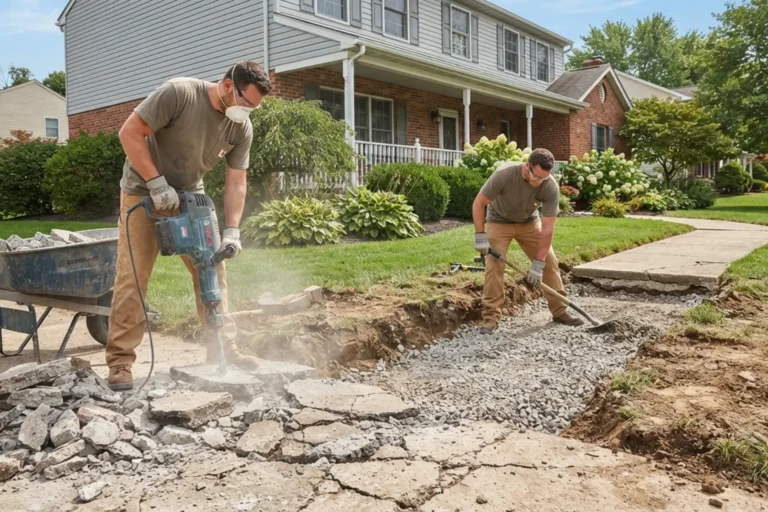
- Removing deteriorated asphalt
- Excavating unsuitable material
- Correcting soft sections
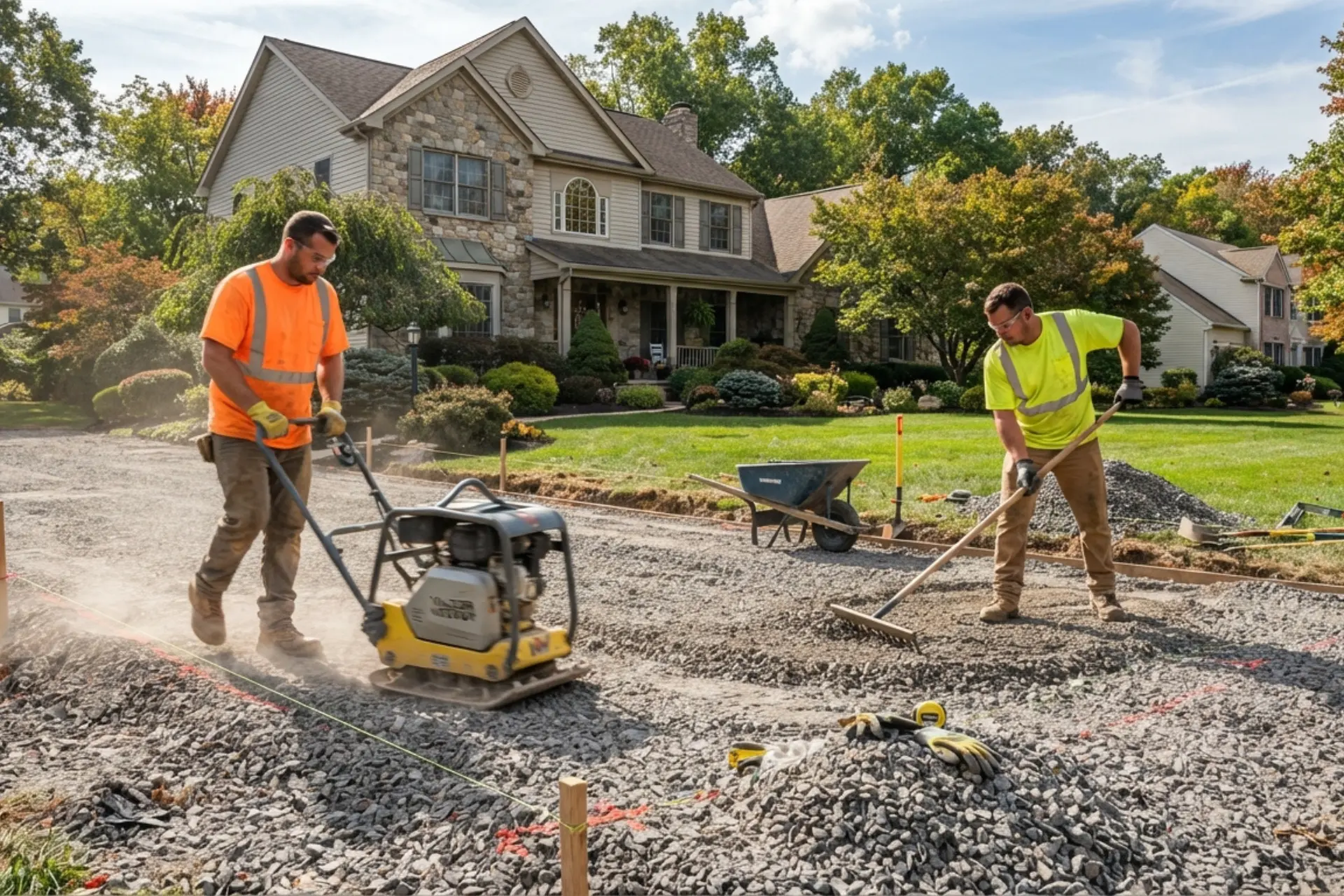
- Installing aggregate
- Establishing required elevations
- Compacting the supporting material
- Preparing pavement edges
A weak or poorly compacted base can contribute to:
- Cracking
- Settlement
- Rutting
- Depressions
- Potholes
- Broken pavement edges
Simply installing new asphalt over unstable material does not correct the reason the previous pavement failed.
How Can You Tell if a Driveway Base Is Failing?
The base itself usually cannot be seen until pavement is removed, but the driveway surface may provide warning signs.
Possible indicators include:
- Repeated potholes
- Large depressed areas
- Widespread alligator cracking
- Uneven settlement
- Pavement movement
- Broken edges
- Repairs that repeatedly fail
These conditions do not always prove that the entire base has failed.
However, they can suggest that the damage extends deeper than ordinary surface wear.
When failure is localized, only specific sections may need reconstruction.
When similar problems occur throughout the driveway, broader replacement may be more appropriate.
Drainage Is a Major Part of Driveway Planning
Water and asphalt pavement are closely connected.
Surface water should move appropriately rather than collecting in low areas or entering weak pavement edges.
Drainage problems can contribute to:
- Base erosion
- Settlement
- Potholes
- Expanding cracks
- Edge deterioration
Water may reach the driveway from:
- Rainfall
- Roof downspouts
- Sloped lawns
- Adjacent parking areas
- Walkways
- Higher parts of the property
- Retaining walls
The driveway should be planned as part of the overall property drainage pattern.
Watch for Water Near the Garage
The garage transition is especially important.
Potential warning signs include:
- Water sitting at the garage door
- Pavement sinking near the slab
- A steep bump into the garage
- Cracking where asphalt meets concrete
- Low areas beside the garage
A replacement driveway may allow some grade correction depending on the property.
Resurfacing provides less flexibility because it adds asphalt on top of the existing surface and increases the pavement elevation.
Garage conditions should therefore be evaluated before selecting an overlay.
Road and Sidewalk Elevations Can Limit Driveway Grade
Many Montgomery County properties must connect the driveway with existing:
- Roads
- Sidewalks
- Curbs
- Concrete aprons
These fixed surfaces influence how the driveway can be graded.
If the garage floor is at one elevation and the road is at another, the pavement must transition between those points while maintaining usable vehicle access and appropriate drainage.
On shorter driveways, there may be less distance available to make that transition.
On longer properties, more of the surface may need to be considered when planning water flow.
When Is Driveway Resurfacing an Option?
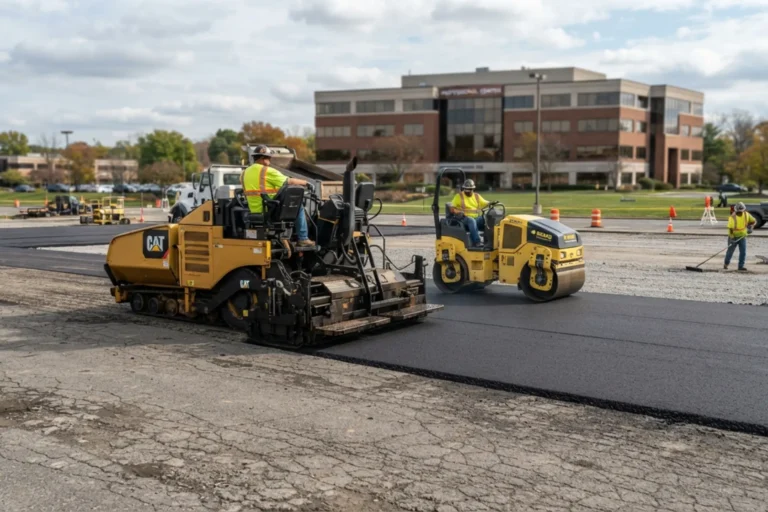
Resurfacing can renew an aging asphalt driveway without removing all of the existing pavement.
The process generally involves preparing the current driveway and installing a new asphalt layer.
A driveway may be suitable for resurfacing when:
- The supporting base remains stable
- Settlement is limited
- Surface wear is widespread
- Structural cracking is limited
- Potholes can be repaired
- Drainage remains functional
- Existing elevations allow another layer
Preparation may include:
- Cleaning the pavement
- Repairing localized failed areas
- Removing loose asphalt
- Correcting potholes
- Preparing pavement edges
- Adjusting transitions
Resurfacing is intended for pavement with usable underlying support.
It should not be used simply to cover major structural failure.
When Is Full Driveway Replacement More Appropriate?
Complete replacement allows the existing pavement to be removed and the supporting material underneath to be evaluated.
Replacement may be more appropriate when the driveway has:
- Widespread alligator cracking
- Significant settlement
- Multiple recurring potholes
- Large failed sections
- Extensive edge breakdown
- Major base deterioration
Depending on the property, replacement may involve:
- Removing old asphalt
- Evaluating the base
- Excavating weak material
- Adding aggregate where needed
- Establishing grade
- Compacting the base
- Preparing transitions
- Installing new asphalt
The ability to correct underlying conditions is one of the primary differences between resurfacing and full reconstruction.
What About Localized Asphalt Repair?
Not every damaged driveway needs resurfacing or replacement.
Localized asphalt repair may be appropriate when only part of the pavement has failed.
Possible repair areas include:
- Potholes
- Broken edges
- Failed utility patches
- Small depressions
- Damage around drains
- Garage transitions
The failed asphalt may need to be removed so the supporting material underneath can be evaluated and rebuilt.
Localized repair can make sense when the surrounding driveway remains stable.
Why Do Potholes Keep Coming Back?
A recurring pothole may indicate that only the surface has been repaired.
The actual cause may remain underneath.
Common causes include:
- Weak base material
- Water intrusion
- Poor compaction
- Settlement
- Edge erosion
If the supporting material continues moving, the patch can eventually fail again.
When potholes appear repeatedly across multiple areas, the condition of the overall pavement should be evaluated.
What Causes Asphalt Driveway Cracking?
Cracking can develop for several reasons.
Common causes include:
- Asphalt aging
- Base movement
- Water intrusion
- Freeze-thaw exposure
- Unsupported pavement edges
- Heavy vehicle traffic
- Utility settlement
Different crack patterns can indicate different conditions.
An isolated crack may be very different from widespread alligator cracking across several sections of the driveway.
The pattern and surrounding pavement condition matter when deciding whether repair, resurfacing or replacement is appropriate.
Can You Widen an Existing Driveway?
Driveway widening can create additional parking space or improve vehicle access.
Possible projects may include:
- Adding a side parking strip
- Expanding near the garage
- Creating a second parking space
- Widening a narrow entrance
- Extending an existing parking pad
Before paving an extension, consider:
- Property boundaries
- Utility locations
- Lawn grade
- Drainage
- Base preparation
- Existing driveway elevation
- Landscape areas
The new section needs appropriate support.
Paving directly over unsuitable lawn or loose soil can cause the extension to settle differently from the existing driveway.
Longer Driveways Require Additional Planning
Some Montgomery County properties may have longer private approaches.
Longer asphalt driveways can require additional attention to:
- Drainage over a larger surface
- Grade changes
- Turnaround areas
- Edge support
- Vehicle circulation
- Base conditions
Water may travel a significant distance before reaching a low point.
The finished driveway should therefore be evaluated as an entire surface rather than treating each section independently.
Compact Residential Driveways Have Different Challenges
Smaller or denser residential properties may have less flexibility.
The driveway may be located close to:
- Houses
- Sidewalks
- Property boundaries
- Neighboring driveways
- Retaining walls
- Walkways
Even small changes in pavement elevation can affect these surrounding features.
This is especially important when deciding whether an overlay is practical.
Driveway Paving in Lansdale, PA
Delaney Construction Paving provides selected driveway paving and asphalt repair services in Lansdale.
Projects may include:
- Driveway replacement
- Asphalt repair
- Resurfacing
- Parking extensions
- Blacktop paving
The existing pavement, base and drainage should be evaluated before determining the project scope.
Asphalt Paving in Montgomeryville, PA
Montgomeryville property owners may contact us about new driveways, replacement paving, potholes and resurfacing.
Parking needs, vehicle use and drainage can all influence the appropriate paving approach.
Driveway Paving in Harleysville and Souderton
Selected services in Harleysville and Souderton may include:
- New driveway paving
- Blacktop replacement
- Driveway widening
- Asphalt repair
- Resurfacing
Properties with different slopes or driveway lengths require site-specific recommendations.
Asphalt Services in Collegeville and Limerick
Driveway projects in Collegeville and Limerick may involve suburban properties, parking extensions, garage approaches and other asphalt surfaces.
The condition of the supporting base and the intended use of the driveway should be considered before paving.
Paving Services in Norristown, Plymouth Meeting and Conshohocken
Properties in more developed areas may include:
- Compact driveways
- Shared access areas
- Rear parking
- Managed-property surfaces
- Selected commercial lots
Projects in these settings may require additional coordination around traffic, access, sidewalks and surrounding elevations.
Driveway Services in Willow Grove and Glenside
Established residential properties may have older asphalt surfaces with:
- Previous patches
- Surface cracking
- Settlement
- Edge damage
- Drainage issues
The amount and type of deterioration help determine whether targeted repair, resurfacing or replacement is more appropriate.
Questions to Consider Before Hiring a Paving Contractor
Before moving forward with driveway paving, ask:
- What is causing the existing pavement damage?
- Is the base still stable?
- Are there standing-water problems?
- Can failed areas be repaired locally?
- Is the driveway suitable for resurfacing?
- Would replacement allow necessary grade corrections?
- Does additional parking require widening?
- How will the pavement connect with the garage?
- Are sidewalks or curbs affecting elevation?
- What vehicle loads will the driveway regularly support?
These questions help define a project that addresses the property rather than only the visible pavement.
Request a Montgomery County Driveway Estimate
Planning a driveway replacement, resurfacing, parking extension or asphalt repair project in Montgomery County?
Delaney Construction Paving can evaluate the pavement, supporting base, drainage, slope and surrounding elevations before recommending an appropriate approach.
We serve selected residential, commercial and managed properties throughout Montgomery County and surrounding Pennsylvania communities.
Phone: (610) 938-7569
Email: info@delaneyconstructionandpaving.com
Address: 857 Callowhill Rd, Perkasie, PA 18944