Brick steps and stoops are exposed to weather, foot traffic, water and seasonal temperature changes throughout the year.
Over time, homeowners may notice:
- Loose bricks
- Crumbling mortar
- Cracked joints
- Broken step edges
- Settlement
- Uneven risers
- Spalling
- Movement in the landing
Some of these conditions may be corrected with localized masonry repair.
Others can indicate that the entrance has moved or deteriorated enough that partial or complete rebuilding should be considered.
The key is determining whether the problem is limited to individual bricks and mortar joints or affects the stability and alignment of the overall structure.
Delaney Construction Paving provides brickwork, steps and stoops, concrete repair and other masonry services throughout selected communities in Bucks County, Montgomery County, Delaware County and surrounding Pennsylvania areas.
Here is how to evaluate whether damaged brick steps may be repairable or need broader reconstruction.
What Is the Difference Between Repairing and Rebuilding Brick Steps?
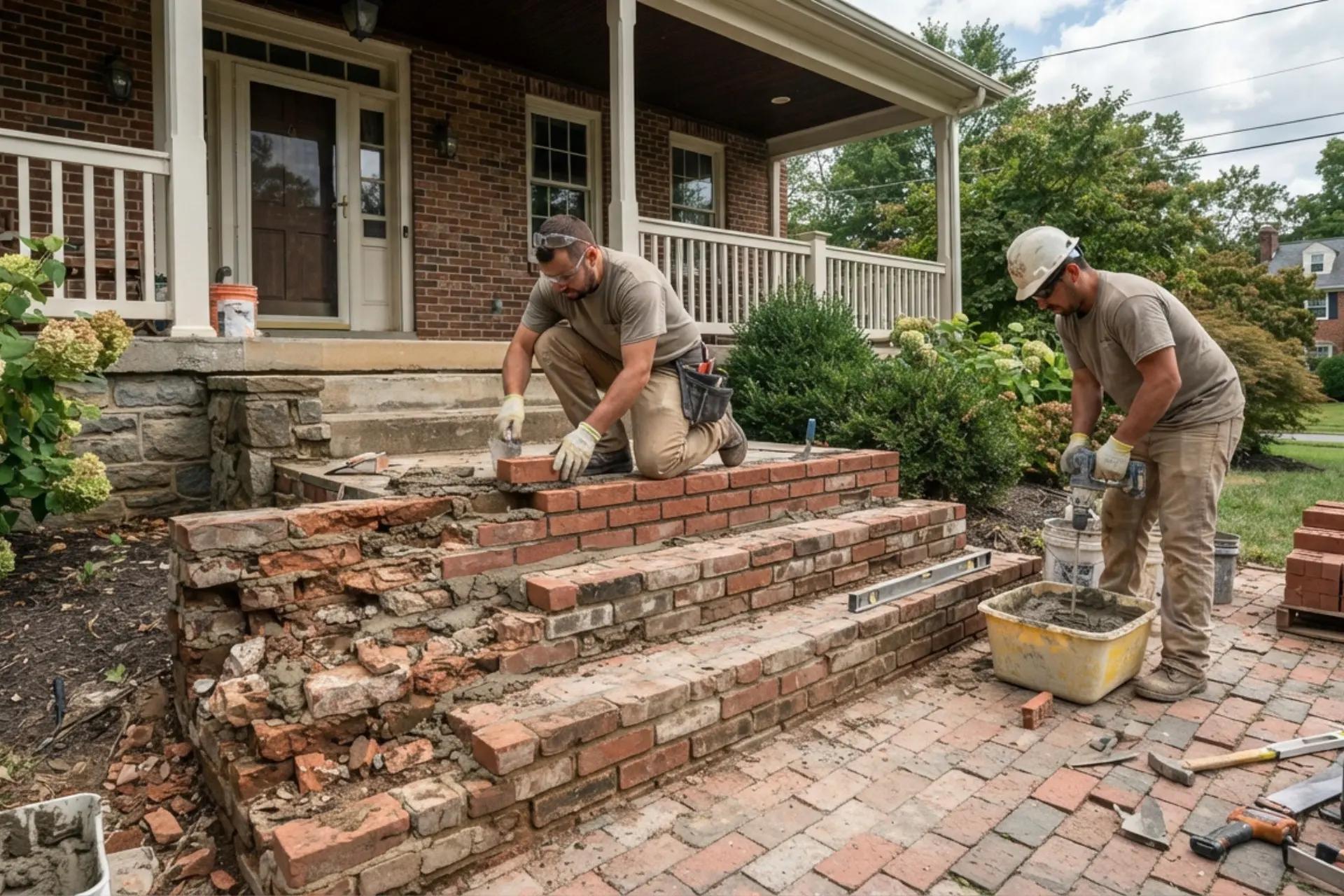
A repair generally addresses a limited area while leaving most of the existing structure in place.
Possible brick-step repairs may include:
- Replacing individual damaged bricks
- Repointing deteriorated mortar joints
- Repairing localized step edges
- Resetting limited loose masonry
- Repairing small landing areas
Rebuilding involves removing a larger portion of the existing masonry so the entrance can be reconstructed.
This may be necessary when:
- Several courses of brick have moved
- Steps have become uneven
- The landing has settled
- Supporting material has failed
- Widespread mortar deterioration is present
The correct scope depends on the condition beneath and around the visible damage.
When Brick Steps May Be Repairable
Localized repair may be appropriate when most of the structure remains stable.
1. Only a Few Bricks Are Damaged
Individual bricks may deteriorate because of:
- Weather exposure
- Moisture
- Impact
- Localized movement
If nearby masonry remains stable, individual brick replacement may be possible.
The damaged brick can be removed and replaced without rebuilding the entire entrance.
2. Mortar Joints Have Deteriorated
Mortar can weather faster than the surrounding brick.
Signs may include:
- Recessed joints
- Crumbling mortar
- Small gaps
- Loose mortar particles
Repointing removes deteriorated mortar from the joints and replaces it with new mortar where appropriate.
Repointing can be useful when the bricks themselves and the overall structure remain reasonably stable.
3. One Step Edge Is Damaged
A localized broken corner or edge may sometimes be repaired if the remainder of the step remains stable.
The surrounding masonry should be evaluated to make sure the damage is not being caused by broader settlement or movement.
4. The Landing Remains Level
If the landing and step structure remain aligned and stable, localized masonry deterioration may be more suitable for repair.
A level entrance with a few damaged bricks is different from one where the entire stoop has shifted.
When Brick Steps May Need to Be Rebuilt
Rebuilding may be more appropriate when deterioration affects the structure rather than only the surface.
1. Several Steps Have Shifted or Settled
Steps should provide consistent, practical transitions between levels.
When multiple steps have moved, homeowners may notice:
- Uneven riser heights
- Sloped treads
- Gaps between masonry sections
- Cracking across several areas
These conditions can indicate movement beneath the structure.
Surface repairs alone may not correct the alignment.
2. The Landing Has Settled
The landing connects the steps with the building entrance.
Settlement may create:
- A gap near the threshold
- Cracks
- Uneven drainage
- Sloping surfaces
- Misaligned steps
If the landing has moved significantly, rebuilding may provide an opportunity to address supporting conditions before reconstruction.
3. The Brickwork Is Bulging
Bulging masonry can indicate movement within or behind the brickwork.
This should not be treated as a simple mortar problem.
Possible contributing factors may include:
- Water
- Base movement
- Loss of support
- Internal deterioration
The amount and cause of movement should be evaluated before repair.
4. Mortar Failure Is Widespread
Repointing is useful when joints have deteriorated but the overall masonry remains stable.
If mortar has failed throughout the steps and bricks have become loose across large sections, rebuilding may be more practical than repairing one joint at a time.
5. Previous Repairs Continue to Fail
Recurring damage can indicate that earlier repairs addressed only the visible surface.
Examples include:
- Repeated loose bricks
- New cracks beside old patches
- Mortar failing shortly after repair
- Continued settlement
When movement continues, the supporting structure may need more complete attention.
What Causes Brick Steps to Deteriorate?
Several conditions can affect exterior brick steps.
Common causes include:
- Water intrusion
- Freeze-thaw exposure
- Mortar weathering
- Settlement
- Weak supporting material
- Poor drainage
- Age
- Previous incompatible repairs
More than one condition may be present at the same time.
How Water Affects Brick Steps
Water can reach masonry through:
- Open mortar joints
- Cracks
- Damaged caps
- Adjacent landscaping
- Poorly drained landings
Repeated moisture exposure can contribute to:
- Mortar deterioration
- Spalling
- Loose bricks
- Staining
- Freeze-thaw damage
Water movement should be considered when repairing an exterior entrance.
Replacing damaged bricks without correcting a recurring drainage problem may allow deterioration to continue.
What Is Brick Spalling?
Spalling occurs when the surface of a brick begins to break, flake or separate.
It may appear as:
- Flaking faces
- Missing outer sections
- Rough or deteriorated brick surfaces
Moisture and freeze-thaw exposure can contribute to spalling.
Individual spalled bricks may sometimes be replaced when the surrounding masonry remains stable.
Widespread spalling may indicate broader exposure or material deterioration.
Why Mortar Compatibility Matters
Not all masonry is the same.
When repairing or repointing existing brickwork, the replacement mortar should be suitable for the surrounding material.
Using an inappropriate repair material can affect how the masonry handles moisture and movement.
Exact color matching may also be difficult because older mortar changes with:
- Weather
- Age
- Exposure
A repaired area may remain somewhat visible even when the work is structurally appropriate.
Brick Steps vs. Concrete Steps
Some homeowners consider changing from brick to concrete when rebuilding an entrance.
Both can be used for exterior steps.
Brick Steps
Brick may provide:
- Traditional masonry appearance
- Coordination with existing brickwork
- Repairable individual units
Concrete Steps
Concrete may provide:
- Monolithic step construction
- Compatibility with concrete walkways
- A different appearance and finish
The appropriate choice depends on:
- Existing building materials
- Entrance layout
- Supporting conditions
- Design preferences
Delaney Construction Paving provides both brick and concrete step services.
What Should Be Checked Before Rebuilding a Stoop?
Before rebuilding, several site conditions should be considered.
These include:
- Door threshold height
- Step rise
- Step tread depth
- Landing dimensions
- Supporting base
- Drainage
- Walkway elevation
- Handrail or guard requirements
Reconstruction creates an opportunity to correct alignment and transitions rather than simply duplicating an existing failed condition.
Walkway Connections Matter
Steps rarely exist in isolation.
They often connect to:
- Concrete walkways
- Asphalt driveways
- Patios
- Sidewalks
If one surface has settled, the transition may become uneven.
A step project should therefore consider the surrounding entrance area.
Can One Brick Step Be Rebuilt Without Replacing the Whole Stoop?
Possibly.
If one section has failed but the surrounding masonry remains stable, localized rebuilding may be practical.
However, removing one step can reveal additional deterioration that was not visible beforehand.
The final repair scope should reflect the actual condition discovered during the work.
Can Loose Bricks Just Be Reset?
Sometimes.
A loose brick may be reset if:
- The surrounding material remains stable
- The underlying support is sound
- Movement is localized
If many bricks are loose, the problem may involve more than the mortar joint.
Broader rebuilding may then be more appropriate.
How Freeze-Thaw Conditions Affect Masonry Entrances
Pennsylvania winters can expose exterior masonry to repeated freezing and thawing.
Water entering cracks and mortar joints can contribute to:
- Brick deterioration
- Mortar loss
- Surface scaling
- Movement
Keeping water from collecting on or entering the masonry is therefore important.
Weather-related deterioration often becomes more noticeable after several seasonal cycles.
Brick Step Repair in Bucks County
Delaney Construction Paving provides selected masonry services throughout Bucks County communities including:
- Perkasie
- Doylestown
- Quakertown
- Dublin
- Warrington
- Mechanicsville
Projects may include:
- Brick step repair
- Stoop rebuilding
- Repointing
- Brick replacement
- Concrete entrances
Brick Step Repair in Montgomery County
Selected Montgomery County service areas include:
- Lansdale
- Montgomeryville
- Harleysville
- Souderton
- Collegeville
- Limerick
- Norristown
- Plymouth Meeting
- Willow Grove
- Glenside
Established entrances may have a combination of older masonry, concrete walkways and previous repairs that should be evaluated together.
Brick Step Repair in Delaware County
Selected Delaware County communities include:
- Media
- Springfield
- Upper Darby
- Havertown
- Broomall
- Newtown Square
- Drexel Hill
- Ridley Park
- Aston
- Brookhaven
- Swarthmore
Properties with established brick entrances may require localized repointing, individual brick replacement or broader rebuilding depending on movement and deterioration.
Common Signs Your Brick Steps Need Attention
Watch for:
- Loose bricks
- Missing mortar
- Cracked joints
- Spalling
- Broken step edges
- Uneven risers
- Sloping treads
- Settled landings
- Bulging masonry
- Water staining
Not all of these conditions require complete rebuilding.
The pattern and extent of the damage determine the appropriate approach.
Request a Brick Step or Stoop Estimate
If your brick steps are loose, cracked, settled or showing deteriorated mortar, the first step is determining whether the damage is localized or part of a broader structural problem.
Delaney Construction Paving can evaluate the masonry, supporting base, drainage, landing and surrounding walkways before recommending repair, repointing, partial rebuilding or complete reconstruction.
We serve selected properties throughout Bucks County, Montgomery County, Delaware County and surrounding Pennsylvania communities.
Phone: (610) 938-7569
Email: info@delaneyconstructionandpaving.com
Address: 857 Callowhill Rd, Perkasie, PA 18944