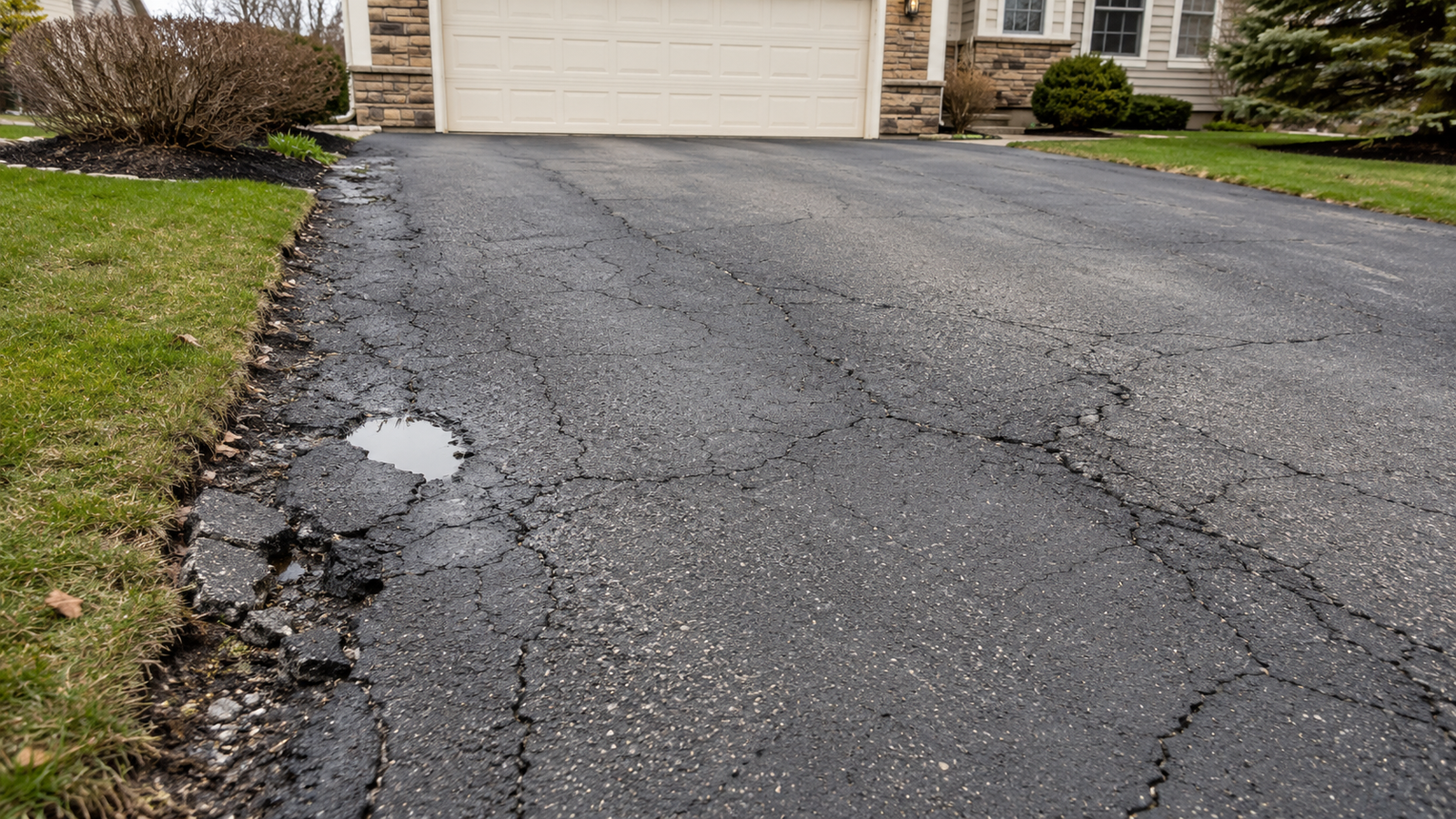
Cracks are one of the most common signs of asphalt driveway deterioration.
Some cracks begin as minor surface defects. Others can indicate movement in the supporting base, poor drainage, settlement or deterioration beneath the pavement.
The important question is not simply whether the driveway is cracked. It is why the cracking is occurring.
Understanding the likely cause can help determine whether the driveway may need localized asphalt repair, resurfacing or complete replacement.
Delaney Construction Paving provides asphalt repair, driveway resurfacing and paving services throughout selected communities in Bucks County, Montgomery County, Delaware County and surrounding Pennsylvania areas.
Here are eight common reasons asphalt driveways develop cracks.
1. Water Is Getting Into or Under the Pavement
Water is one of the most important factors affecting asphalt pavement.
When water enters cracks, pavement edges or poorly drained areas, it can reach the supporting base beneath the asphalt.
Over time, this may contribute to:
- Base erosion
- Soft areas
- Settlement
- Potholes
- Edge failure
- Expanding cracks
A driveway may appear damaged only at the surface while the actual problem is developing underneath.
Standing water can also indicate that the pavement has settled or that the original grade is no longer directing runoff appropriately.
Signs of Drainage-Related Asphalt Damage
Watch for:
- Water collecting in depressions
- Cracking around low areas
- Repeated potholes in the same location
- Eroded pavement edges
- Settlement near drains
- Water moving toward the garage
Drainage problems should be evaluated as part of the overall paving or repair plan rather than treating the visible crack alone.
2. The Supporting Base Is Weak or Failing
The asphalt surface is only the visible part of a driveway.
Beneath it is a supporting base that helps distribute vehicle loads and keep the pavement stable.
If this material is:
- Too thin
- Poorly compacted
- Washed out
- Contaminated with unsuitable soil
- Softened by water
- Disturbed by previous work
the asphalt above can begin to move.
That movement may appear as:
- Cracking
- Depressions
- Rutting
- Settlement
- Potholes
- Uneven pavement
Simply filling the cracks may not provide a lasting result if the supporting material continues to move.
In those situations, the failed pavement may need to be removed so the base can be corrected before new asphalt is installed.
3. Freeze-Thaw Cycles Are Expanding Existing Cracks
Pennsylvania asphalt surfaces experience repeated seasonal temperature changes.
When water enters a crack and temperatures fall, freezing conditions can contribute to expansion and movement.
As temperatures rise again, the material thaws.
Repeated cycles can gradually worsen existing pavement defects.
This can contribute to:
- Wider cracks
- Loose pavement
- Surface breakup
- Potholes
- Damaged edges
Freeze-thaw exposure does not necessarily create every driveway problem by itself.
However, when cracking or water intrusion already exists, seasonal weather can accelerate deterioration.
Addressing small areas of pavement damage before they become widespread may help limit further surface breakdown.
4. Asphalt Is Aging and Losing Flexibility
Asphalt changes as it ages.
Exposure to:
- Sunlight
- Air
- Rain
- Temperature changes
- Vehicle traffic
can gradually affect the pavement.
Older asphalt may become less flexible and more prone to cracking as it expands and contracts.
Common age-related signs may include:
- Faded pavement
- Fine surface cracking
- Brittle edges
- Small loose aggregate
- Increasing crack frequency
Age alone does not automatically mean a driveway needs complete replacement.
The condition of the base, crack pattern, settlement and drainage are often more important than the number of years the pavement has been in place.
A stable older driveway may sometimes qualify for driveway resurfacing, while a newer driveway with major base failure may require more extensive work.
5. Pavement Edges Do Not Have Enough Support
Driveway edges can be vulnerable because they are not always supported by pavement on both sides.
If the ground beside the asphalt erodes or drops away, the edge may begin to crack or break under vehicle loads.
Common edge problems include:
- Long cracks near the outside of the driveway
- Broken asphalt pieces
- Crumbling edges
- Pavement sinking toward the shoulder
- Wheel-path damage near the edge
These issues may be made worse by:
- Vehicles driving too close to the edge
- Water runoff
- Poor shoulder support
- Landscape erosion
- Repeated heavy loads
Localized repair may be possible when damage is limited.
If edge failure occurs throughout the driveway and is combined with broader cracking or settlement, more extensive work may be needed.
6. Heavy or Repeated Vehicle Loads Are Stressing the Pavement
Residential asphalt driveways are designed around expected vehicle use.
Repeated heavier loads can place additional stress on the pavement and supporting base.
Examples may include:
- Delivery vehicles
- Work trucks
- Trailers
- Moving trucks
- Construction vehicles
- Larger recreational vehicles
Areas where vehicles repeatedly turn, stop or park may experience more concentrated stress.
This can contribute to:
- Rutting
- Depressions
- Cracking
- Edge failure
- Surface movement
The effect depends on the pavement thickness, base condition, soil and frequency of the load.
If a driveway will regularly support heavier vehicles, that expected use should be considered during paving and base preparation.
7. Utility Work or Previous Excavation Has Settled
Driveways sometimes contain areas that were previously disturbed for:
- Water lines
- Sewer lines
- Drainage work
- Electrical service
- Gas lines
- Other underground utilities
Even when the pavement is repaired afterward, the excavated area may settle differently from the surrounding driveway if the supporting material was not restored or compacted adequately.
This can create:
- Straight or rectangular crack patterns
- Depressions
- Failed patches
- Repeated cracking along repair edges
The correct repair may require removing the affected pavement and evaluating the material beneath the patch.
Simply applying another surface layer over continuing settlement may not resolve the problem.
8. Previous Repairs Did Not Correct the Underlying Cause
A driveway may have several old patches but continue to deteriorate.
This often happens when repairs address the damaged asphalt without correcting the reason it failed.
For example, a pothole may be filled while:
- Water continues entering the area
- The base remains weak
- Settlement continues
- Pavement edges remain unsupported
The repaired area may then fail again.
Repeated patching can make sense when damage is truly localized.
When similar defects continue appearing throughout the driveway, it may be time to evaluate whether resurfacing or replacement offers a more appropriate solution.
What Different Crack Patterns Can Tell You
The appearance of the cracks can sometimes provide clues about what is happening.
Single or Isolated Cracks
One or two cracks may result from normal pavement movement, localized settlement or a specific weak area.
These may sometimes be candidates for repair depending on the surrounding condition.
Edge Cracks
Cracks along the driveway perimeter may indicate inadequate edge support, erosion or water movement.
Longitudinal Cracks
Cracks running in the direction of the driveway can result from pavement movement, construction joints or settlement.
Transverse Cracks
Cracks running across the driveway may be associated with temperature movement or underlying conditions.
Alligator Cracking
A network of small interconnected cracks resembles the pattern of alligator skin.
This type of cracking commonly suggests structural deterioration or base failure rather than a simple surface defect.
Widespread alligator cracking is an important sign when deciding whether resurfacing is still appropriate.
Should You Repair, Resurface or Replace a Cracked Driveway?
There is no single answer for every cracked asphalt driveway.
The correct approach depends on the extent and cause of the deterioration.
Localized Asphalt Repair May Be Appropriate When:
- Damage affects a small area
- Potholes are isolated
- The surrounding pavement remains stable
- Settlement is limited
- The base can be corrected locally
Resurfacing May Be Appropriate When:
- The base remains stable
- Most deterioration is near the surface
- Cracks are repairable
- Settlement is minor
- Existing elevations permit another asphalt layer
Replacement May Be More Appropriate When:
- Alligator cracking is widespread
- Multiple areas have settled
- Potholes repeatedly return
- Large sections of the base have failed
- Drainage problems have caused extensive deterioration
A site evaluation can help distinguish between these conditions.
Can You Simply Fill Asphalt Cracks?
Crack filling can be useful in some maintenance situations, but it does not correct every type of pavement failure.
A crack caused by surface movement may be different from a crack caused by:
- Base settlement
- Soil movement
- Water erosion
- Utility settlement
- Structural pavement failure
If the underlying material continues moving, the crack may return even after the surface is treated.
The cause matters as much as the crack itself.
Why Drainage Should Be Part of Driveway Repair Planning
A driveway is part of the property’s overall drainage pattern.
Water may come from:
- Rainfall
- Roof downspouts
- Lawn runoff
- Sloped neighboring areas
- Garage gutters
- Higher sections of the property
Before paving or repairing a driveway, it is important to understand where that water is moving.
Simply creating a smooth new surface does not guarantee that drainage has been improved.
The final grade should work with the surrounding property rather than directing water toward buildings or creating new low areas.
How Driveway Resurfacing Can Help Surface Cracking
When the base remains stable, resurfacing may provide a new wearing surface over an aging driveway.
Before resurfacing, localized failures may need to be corrected and the existing pavement prepared.
However, resurfacing is not intended to hide serious structural failure.
Widespread settlement or base-related cracking can eventually transfer into the new surface.
That is why driveway condition should be evaluated before selecting an overlay.
Asphalt Driveway Repair Across Pennsylvania Service Areas
Delaney Construction Paving provides asphalt repair and driveway paving for selected properties throughout:
Bucks County
Including:
- Perkasie
- Doylestown
- Quakertown
- Dublin
- Warrington
- Mechanicsville
Montgomery County
Including:
- Lansdale
- Montgomeryville
- Harleysville
- Souderton
- Collegeville
- Limerick
- Willow Grove
- Glenside
Delaware County
Including:
- Media
- Springfield
- Upper Darby
- Havertown
- Broomall
- Newtown Square
- Drexel Hill
- Ridley Park
- Aston
- Brookhaven
- Swarthmore
Property conditions vary from one driveway to another, even within the same neighborhood.
The visible crack pattern should therefore be evaluated together with the base, drainage and surrounding conditions.
Request an Asphalt Driveway Evaluation
If your driveway keeps cracking, patching the visible damage may not be enough.
Delaney Construction Paving can evaluate the pavement, supporting base, drainage, settlement and surrounding conditions to determine whether localized repair, resurfacing or replacement may be appropriate.
We serve selected properties throughout Bucks County, Montgomery County, Delaware County and surrounding Pennsylvania communities.
Phone: (610) 938-7569
Email: info@delaneyconstructionandpaving.com
Address: 857 Callowhill Rd, Perkasie, PA 18944